Site map
JP
Company
Products
Technology
Manufacturing
Sustainability
Investor Relations
Print
Instrument Panel
Light-Transmissive Surface Panel
Decoration Panel
Rear Console
Indicators
The cockpit—an interface between the vehicle and the driver & passengers—is important not only for safety, but also for creating a space that multiplies the comfort and enjoyment of driving many times over. We bring out the potential of plastics and help create a luxurious and comfortable space.
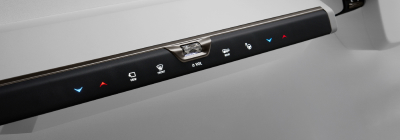
Image: Responsive Hidden Switches installed in the new Toyota LEXUS ES
(Developed in collaboration with Tokai Rika Co., Ltd.; DaikyoNishikawa Corporation was responsible for the Light-Transmissive panel section.)
Simultaneous development of a PVC powder slush molding material and a urethane foam material was intended to create the ideal touch and feel. We have achieved a comfortable tactile impression that appeals to the senses. In addition, for the front passenger airbag, an invisible airbag structure has been adopted to impart an improved appearance. This structure, unlike the conventional separate structure between the airbag and the lid, is integrated with the instrument panel so as to hide the parting line of the airbag deployment opening in front of the front passenger seat to the effect that the equipment is inconspicuous. Furthermore, having evaluated airbag deployment performance in-house, we have fulfilled both appearance and safety requirements.
We supply customers with instrument panels provided with real stitches. This was made possible through research and development pursued to apply stitches so that thin PVC surfaces powder-slush-molded into a three-dimensional style would look carefully crafted. It was success in stably applying real stitch lines even on a material that stretches and tears more easily than fabrics. The key to the success was incorporation of our proprietary expertise into industrial sewing machines to meet the needs of the market and customers who demand a more authentic feel. Moreover, we have designed a process that can automatically distinguish various thread colors, enabling high-mix low-volume production and inventory optimization.
DaikyoNishikawa’s proprietary technology integrates display functions beneath a soft-touch surface, clearly displaying icons and information only when needed. When not in use, it creates a seamless, refined interior design, while in use, it provides excellent visibility and intuitive operation through physical switches. By combining sophisticated design with functionality, this technology creates new value for next-generation vehicle interiors.
*HMI…Human Machine Interface
This technology combines DaikyoNishikawa’s light-transmissive decoration technology with Tokai Rika’s switch unit to achieve a world-first innovation*. The controls appear only when needed, combining refined design with excellent visibility while providing a distinct tactile response when pressed.
This technology is installed in the new Toyota LEXUS ES.Pless release is here.
*According to our research
To reproduce a higher level of texture, it is necessary to design a sophisticated form.
Leveraging our technical expertise built through experience in upholstering, we make development efforts so as to faithfully reproduce the designed form.
What we have developed is not limited to the function of providing support to the passengers. We have developed a structure that is sufficiently rigid for intuitive operation and is extremely user-friendly. In addition, the product design has also pursued quality (comfortable tactile sensation).
In 2019 DaikyoNishikawa began to mass-produce gear shift indicators for automobiles. The basic technology used in them was a microcontroller equipped with a single integrated circuit comprising communication between multiple Electronic Control Units (ECUs) and Light Emitting Diode (LED) control. The gear shift indicator is also equipped with a circuit that minimizes standby current.
Integrated development of electronic parts and plastic parts has enabled us to develop parts that are stylish and offers uniform aesthetic quality.
In 2016, with the advent of CASE, DaikyoNishikawa began full-scale development of automotive electronic parts to take on challenges in an area new to the Company.
Comprehensive development spanning from mechanism/circuit/software design to mass production enables the Company to improve the quality and speed of its development approach meeting market needs and to develop products that combine its unique technology with electronic technology.
Inquiry Form